2026—the year in books
This year’s book count was a staggering (for me) 177.
I’ve definitely upped my total reading count by both becoming an empty nester & adopting the Libby app for a lot of my genre fiction reading (which means I’m constantly returning library books & taking a new one out at 2 am, which is way more convenient in my jammies on my iPad than having to do it the old-fashioned way—but of course, I did not cross the virtual picket line, during the DC 33 strike!).
Here are the best books of my year, in chronological order (of my having read them, not publishing):
The Name of War Jill Lepore
The Blazing World Siri Hustvedt
All Systems Red Martha Wells
Tasting Freedom Daniel Biddle & Murray Dubin
Welfare Warriors Premilla Nadasen
Liquid Mariam Rahmani
Union Jack Scott Mintzer
An Absolutely Remarkable Thing Hank Green
A People’s Art History of the United States Nicolas Lambert
Unmarketable: Brandalism, Copyfighting, Marketing & the Erosion of Integrity Anne Elizabeth Moore
Good Dirt Charmaine Wilkerson
The Mountains Wild Sarah Stewart Taylor
Rivers of Rhythm: African Americans and the Making of American Music
Spent Alison Bechdel
A Botanist’s Guide to Flowers & Fatality Kate Khavari
Wild Dark Shore Charlotte McConaghy
Marsha Tourmaline
Let the Record Show Sarah Schulman
Black Ice Lorene Cary
sometimes, you’ve got to put your bodies upon the gears…
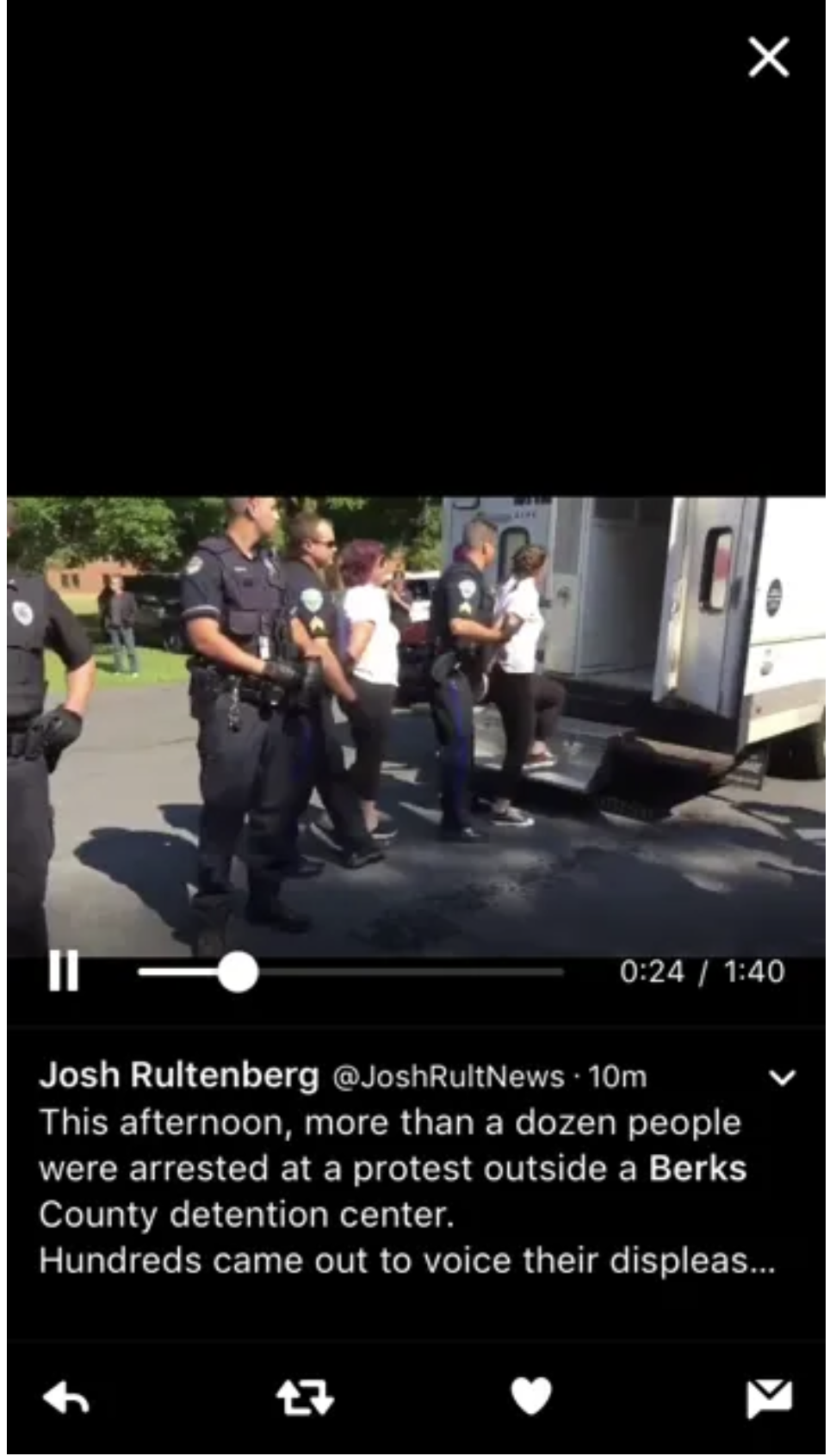
Yesterday afternoon, my daughter and I got arrested along with about a dozen immigrants and allies, for blocking the road outside the Berks Family Detention Center. This action was part of a years-long campaign led by immigrants and their supporters in PA, calling on Governor Wolf to issue an Emergency Removal Order and to close this facility.
Hear from people detained at the center:
“My message for the Governor of Pennsylvania is to close the Berks Detention Center. It is unjust that the children and mothers and now fathers are in that place. And instead of finding protection, we find a prison. It is unjust. That is why I ask the Governor to please close the Berks center. My belief is that no family, regardless of their color, race, regardless of their country, of what part of the world they come from, they should not be put in prison.” — Lorena, mother held for nearly two years with her son
“The first thing that I would ask him (Governor Wolf) is just to make the wrong right. There’s no need to say that a state would lose jobs because we are asking them to shut down this place. The same staff can provide human services for immigration. The same staff that you are using right now as guard in prison they can become human service providers. The same place that you have right now can break out their locks, open their rooms for people who really needs a place to live. Who really needs some medical assistance where they are fighting for their legal right. We don’t want to get anything illegal. We are not looking for charity. We are just looking for legal paths for our legitimate cases. Finally, I just want him to think for a moment if he were in the place of any one of those fathers or mothers, how would he like to be treated.” — Waddah, father detained for six months with his daughter
If you are moved to do so, please contribute to the organizations that have been working on this campaign, and for the legal defense of the protestors, here.
As a parent, the thing I want most is for my kids to grow up safe and happy, and to feel the world around them is a welcoming place. Everybody’s kids deserve that. We shouldn’t be putting families in prison, not just because it hurts those families, but because it hurts our whole society. No one’s kids can grow up safe and happy, in a society that is broken and unwelcoming.
Is there irony, in getting arrested with my kid to protest other people’s families being locked up together? Probably, but for now I’m mostly just tired and a little sad about the state of our world (and also proud of her for committing her first act of civil disobedience, at 18).
If you’re proud of her too, please contribute to her favorite Latinx community organization, Make the Road PA.
Mario Savio, hero of the Free Speech Movement at Berkeley once said, “There is a time when the operation of the machine becomes so odious, makes you so sick at heart, that you can’t take part. You can’t even passively take part! And you’ve got to put your bodies upon the gears and upon the wheels, upon the levers, upon all the apparatus, and you’ve got to make it stop! And you’ve got to indicate to the people who run it, to the people who own it — that unless you’re free, the machine will be prevented from working at all!”
This machine can’t keep working. Listen to the families, and donate to the fight.
*h/t to Melissa Byrne for grabbing this screenshot of the two of us
Why not just fund all the lawyers?
This is a lightly-edited version of an email I sent to a team I work with, about why we should be focused on raising money for grassroots groups, in addition to legal organizations and political campaigns directly, to fight the threat of a stolen election.
I am writing this from the perspective of Pennsylvania, as that is obviously the state that I know best — but I can imagine that scenarios I could see happening in PA are also possible in any of the other Big 5, particularly Wisconsin (which shares the PA problem of not starting the vote count of mail or absentee ballots until Election Day itself). The Commonwealth of Pennsylvania has only run one election where the majority of voters were eligible to vote by mail — it happened this past June, and it took about 10 days to certify statewide results.
There are any manner of good analyses of how the Trump campaign might attempt to subvert the election, including Jeffrey Toobin’s recent New Yorker article, and the Atlantic piece that details the outsized influence that state legislators may attempt to invoke. Here’s a good analysis from yesterday’s Inquirer, about the various challenges that the Trump campaign is already throwing up against the wall in PA around Philly voting — I’m sure you could find similar pieces in the major papers of cities in all the battleground states. The purpose of this piece isn’t to make you more stressed out and scared about all the nefarious legal machinations that may come our way between now and January 20, 2021, it’s to talk about why, in order to fight those legal machinations, we need to fund organizing, not just lawyering.
So what are the kinds of things that we’ll need organizers to do, in the period between Election Day & the Inauguration?
First and foremost: The fundamental job of an organizer is to explain things about a system to people in language they can understand, and move them to take action to change it. If the organizers that we are investing in during the pre-election period are effective — and I believe that they are — then they will be the most trusted messengers in their communities after the election too.
In the post-election period, in addition to smart lawyers who can win in court, we also need to be able to win in the court of public opinion. Here are some ways that our groups can and should be asked to do that:
Press enter or click to view image in full size
Explain to people in their communities what is going on and how to fight it. There will be a lot of work, on the Republican side, to make people feel like this is a fight around complicated legal issues that are hard for the average person to understand, so please just go about your business while the lawyers work it out. We will need to fund massive organizing to explain to people things like, “hey, the only other time a lot of people voted by mail in PA, it took 10 days to count the votes, so don’t stress, this is normal.”
Find plaintiffs. In many states, in order to file a lawsuit about a bad outcome for voters, you need named plaintiffs — people who were actually harmed by whatever the thing is that the lawsuit is about. Sometimes, in order to file a statewide election, you need plaintiffs from multiple counties or jurisdictions to show that the damage was state wide and not confined to one city. Our groups are tracking voter registrations (including those that are rejected) and vote-by-mail applications, and will know which of their community members have good cases that show systemic problems. They will also be more trusted by a voter they have already engaged with/have helped through a voting problem. It is not easy to convince a “normal” (ie — not someone who spends their Sunday mornings writing memos about organizing) person to sue the President of the United States. It helps if you already have a relationship, and can rely on trust and the feeling that someone local has your back.
Press enter or click to view image in full size
Run mass texting or phone banking operations. Again, these may be directed at state legislators, at county election officials, at governors, at members of Congress, at the Senate, at members of the Electoral College themselves — there are multiple public actors who will have the opportunity to do bad (or good), in the post-election period. We should make sure that the groups in whatever state needs this have all the resources that they need — which might even require more money than they needed in the election. Elections have finite universes — for example, in most cases, you aren’t necessarily spending a lot of time organizing people who are too young to vote, or who are ineligible to vote for whatever reason. That doesn’t mean you don’t call them to take action when our democracy is jeopardized. A person who lives in a Congressional district is that Congressperson’s constituent, even if they are too young to vote for that Congressperson. They can and should be given the opportunity to make their voices heard.
Press enter or click to view image in full size
Organize mass demonstrations. We’ve come a long way in democratizing the ability to organize demonstrations in the past four years, happily. But, to be honest, we cannot afford to have demonstrations that are seen as largely white-led, which is what we have seen a lot of, in demonstrations that are electorally-related, because volunteer white Democratic activists still have not learned enough about organizing BIPOC allies. (I want to be clear that I am not referring to the demonstrations that have been organized by BIPOC communities & their allies around community issueslike police murder, DACA, the end of TPS, the Muslim ban, lack of PPE for essential workers, etc.). Did you go to one of the memorials for RBG, hosted at federal courthouses last month? Was it largely white? ‘Nuff said.
Organize direct actions. All the Democratic political advisors in the world will not come up with the creative kinds of disruptions that our groups will, because Democratic advisors are part of the system. Do not ask people who directly benefit from a system to come up with ways to shut it down.
Organize community defense networks. Heavily-armed, right-wing “patriots” are not going to be coming to the kinds of neighborhoods where I and many of our other white staff & donors live, to impose their visions of ‘law and order’ — either before the election or after. If they come to mine, I can reasonably expect to call the cops and survive the call. That is not true for most of the BIPOC communities where our groups are organizing.
Continue to organize mutual aid, as the political system in the US grinds to a halt. Do we believe that we are getting some new covid-19 relief legislation through Congress, while the entire US political system is in a street fight with itself about the continuity of government? If not, we better have a plan for how to help people survive the coming wave of layoffs and evictions.
I hope this is helpful to folks who are working on their late election fundraising pitches, and welcome added information or feedback from the other staff who work directly with grassroots groups about things I’ve left out or that are not clear enough.
Why do we let our kids learn about work from bosses?
This post is a little more personal that my usual work on HtU. I struggled with whether to put it up here, or just write it somewhere else–but it seems to be more relevant to HtU readers than anyone else.
I’ve been thinking a lot lately about the activism of young people. I’m the mom of two teenagers, for one thing. I’ve been involved in some of the organizing work around the #fightfor15, in Philly, which is a movement largely made up of young workers. There’s the unprecedented wave of activism about gun violence that’s been sweeping the US, since the Parkland shooting that’s led up to today’s #marchforourlives. And finally, there’s the fact that I’m currently working on a campaign that involves retail workers, a group the media and elected officials constantly want to claim are “just students” or “just in entry-level jobs.” It’s made me conclude that we aren’t doing enough in the labor movement to teach kids, from the very beginning, how to stand up for themselves at work.
My daughter^ was a high school senior when she entered the formal workforce last year, through the kind of semi-crappy food service job that lots of us experience in our work lives. On her first day of training, the manager tried to convince her that she shouldn’t take breaks, even if she was legally allowed to take them. Of course, a young woman who has grown up with two parents that work in the economic justice movement isn’t going to buy that–but it made me wonder–where would she have learned it, if not from us? There isn’t ever a class that teaches you, “here’s what your rights at work are, even as a teenager, and how to assert them.*” Later on in that same job she experienced wage theft, and again, she pushed back on it (and eventually won the money)–but it was in the kind of situation where most people in their first job might think, “Oh, the boss says this is a rule I don’t understand, so I guess I’ll just go along with it–I’m new, and I don’t want to piss him/her off.”
In the waves of organizing around the Fight for 15, and Fair Scheduling, the messaging themes from low-wage employers & their political allies are focused on the fact that, for many middle-class white people, service jobs are just an entry to the workforce. They’re counting on the fact that people like me–educated, middle-class, middle-aged–will look back on their first jobs and think, “well, I survived that stupidness and now I’m successful, why can’t everyone do that?” They’re counting on our privilege to blind us to the reality of life for young people in the US today.
But they’re also doing something else. They’re also counting on those low-wage employers to teach kids (some of whom will grow to adults with ‘real’ jobs) that fighting the system doesn’t work. That your boss has power over you that should go unquestioned, even if it doesn’t seem fair, because that’s just how it is.
They’re counting on low-wage employers to indoctrinate teenagers into believing that wage exploitation is fair.
And that doesn’t just help fast food and big box retail employers keep control of their workforces–it helps all bosses keep control of their workforces.
If, in your very first job, you get told “you don’t deserve fairness,” do you start believing it about every job? If you experience wage theft in your first paycheck, and you don’t know what to do about it, where do you ever learn to fight it? If you’re told, when you’re sixteen, “oh, it doesn’t matter that the minimum wage hasn’t gone up in ten years, that’s not supposed to be enough money to live on” what do you do when you get into that ‘real’ job and don’t get a raise for ten years?
I’ve talked to a lot of young people in movements (not just the labor movement, but in other fights for social justice) about their struggles at work and around living with low-wage employment. Invariably, all of them have said to me some version of “nobody ever taught me anything about my rights, or how to do anything about it when I got screwed at work.” What that says to me is that my generation of organizers, and the generations before me, haven’t done enough thinking about the kinds of practical skills that young people can use to fight authority, whether they are in a union or not.
And let me be clear–I’m not talking about teaching labor history. There is, of course, a strain of thought in the labor movement that thinks we should focus on teaching people to be grateful for the things the labor movement won–things like the 8-hour day, and the minimum wage, and protection from child labor. Did I mention that I’m the parent of teenagers? Even the best of them are not always full of gratitude for the sacrifices of those who came before them.
We don’t need to teach kids what it was like to work for terrible employers in the early 1900s. They’re living it now. We need to teach them how to resist it in today’s terms, not by creating nostalgia for the fights of the 1930s.
So go out and find that group of kids who organized a walkout of their high school, and talk to them about justice on the job. Go out and find the youth organizers fighting for education justice, and fund them to teach kids how to talk to their managers about scheduling problems while they do the rest of their work. Find that young organizer in your union or worker center, and let her build a youth committee–even if it isn’t going to lead to an immediate organizing drive. Think of it as your investment in fighting the boss in five years, or ten, or fifteen.
Because a sixteen year-old who learns that they have the power to say no to skipping breaks, in their first week as a barista, is going to grow up into the kind of member that every union wants. The seventeen-year-old stocking shelves in a big-box store who learns to appreciate the power of collective action, when the boss cuts their hours and the rest of the shift stands up and won’t let the boss get away with it, will someday be on your bargaining committee. And the eighteen year-old who fights for $15 while working at the dollar store is going to grow up to run your union someday.
^Thanks for letting me use your story!
*I did email the superintendent of her school to suggest that they add a section on labor rights to the school’s Financial Literacy class, which is required for all juniors. He agreed to do it, so we’ll see how that goes when my son gets there.
Who do you build solidarity with?
If the early Trump era has taught us anything, it’s that we can’t afford to be siloed in our work to build power for the precarious. The Administration, along with its allies in Congress, has proved that they are able to carry out multiple attacks on our hard-fought victories–sometimes within the span of a single day–even while managing a news cycle that seems to explode hourly with new signs of the president’s slipping grasp on reality.
We’re coming up on the one-year anniversary of the Women’s March (and of course, of the inauguration that preceded it), which kicked off a year of massive mobilization to demonstrations, hearings, town halls and rallies across movements. And of course, we’re also about to hit the 50-year anniversary of the Poor People’s Campaign, which is being revived for the 21st century by Rev. Barber and many others.
It’s got me thinking a lot about the concept of solidarity and how it is practiced (or sometimes just given lip service to), in the US–particularly for unions who, in earlier decades, fought the fights that brought the majority of their members into the middle class.
I’d challenge all of us to ask ourselves, our leaders, and our friends the following questions:
Does your practice of solidarity require you to enlist your middle-class members in the #fightfor15?
Does your practice of solidarity require you to educate your white members about why #blacklivesmatter, and to get them in the streets?
Does your practice of solidarity require you to recruit the men in your membership into fighting sexual harassment? And to understand why reproductive justice is an economic issue, as well as a health care one?
Does your practice of solidarity require you to confront your US citizen members with the need to defend the undocumented and the DACA-mented?
Does your practice of solidarity require that your abled members stand up for the disabled, on and off the job?
Does your practice of solidarity require you to press your straight members into fighting for LGBTQ rights?
For progressive, membership-based organizations, the practice of solidarity requires political education of the members. We won’t get to where we need to be until we start talking to our members about our analysis of power–how it is created and held, how we are complicit in it (some more than others), how we are going to fight it and win.
We can’t build a movement for economic justice unless we expand our concept of solidarity beyond the borders of our own organizations. Nor should we keep spouting the word “solidarity” without actually showing up to do the work that makes it real.
For the next year, at Hack the Union, I’m looking to highlight stories of solidarity-building–and in particular, to delve into the strategies that organizers are using, to build alliances across difference. If you know of an organization that’s doing great work in this arena, send me a tip.
why expanding the map matters (Pt. 2)
There’s a popular trope in electoral organizing that involves a young field organizer, dropped into a turf which hasn’t seen a contested election in a while, who tries to bring the newest tactics in their ground game and is told by the county chair, “That’s not the way we do things around here*.” Spoiler: the young organizer does it her way despite the resistance of the entrenched party, and wins the election.
While we don’t have a federalized election process in this country, our elections, for organizing purposes, are still pretty much on a plug-and-play model. There are variations from one state to another–is there early voting? how hard or easy is it to vote by mail? is there same-day voter registration? But at the end of the day, there are similar rules to follow from one place to the next. Both sides are competing for a fixed endpoint. Pro-worker electoral organizers may not get to set the rules of the election in one place or another, but we do know what they are–as government practices go, the rules for elections are transparent. As a result (while not advised), it is possible to win elections by dropping organizers into a place they don’t know well.
We get into problems, though, when we think we can win policy or worker organizing victories with this kind of plug-and-play thinking–especially when the reliance on plug-and-play means we don’t invest in places where sustaining work is harder. Organizing for policy victories–or organizing to build community support for workers who are taking actions to build power at work that could risk their jobs–both require the kinds of relationship building that plug-and-play organizing doesn’t prioritize.
Particularly when it comes to organizing in support of policy, it is imperative that local organizers understand the mechanics of how their government works–and the rules for how to affect legislation at the city or state level are rarely as clear as those that govern how elections are run. We have made a collective decision that, as a democracy, the state has to at least give the appearance that outsiders can win elections. We have not come to a similar collective conclusion about making the legislative process transparent.
In the last post, I talked about the need to invest in organizing ecosystems, not just individual organizations. As we think about what comes next, in the evolution of the labor movement and worker organizing, it is unlikely that we will see the exact replication on a wide scale of the functions that local unions and their internationals play in the movement. Let’s think about what a 501c5-style labor union can do, in addition to both representing current members and organizing new ones. Unions can make endorsements and spend money on electoral organizing within their membership base; can have a legal department that focuses on electoral law and legislative expertise, as well as labor and/or immigration law; can invest in a legislative director or team that is embedded in policy & legislative work focused at the state or city level; can have organizers that are responsible for building relationships with faith leaders and other community organizations with similar goals; and can have a communications department that is focused both on producing internal content for members and on producing issue-based content that targets the general public. Some unions also have affiliated PACs that can raise hard money from their members, which can be used to influence the general public in elections or can be contributed to candidates running for office. There are, to my knowledge, no other kinds of organizations in our movement that have this kind of flexibility in combining organizing work with electoral & legislative advocacy–this is the kind of ecosystem, however, that we need to be thinking about, if we want to build deep support for organizations that want to win for workers.
What if every national funder, network or organization, when making their plans for expanding investment into worker organizing in a particular city or state asked themselves the following questions:
Does the ecosystem in this place provide legal support, that will both support individual workers in fights on the job and also support a broader strategy for changing the landscape through policy change or litigation?
Does the worker organization have a civic engagement strategy to build the habit of voting among its members, or a partnership with a local group that will help with that?
What partners in the region will be helping to drum up community support for this effort? If the organization plans to do this itself, is it adequately resourced to build relationships, or is this an add-on for an already-stressed worker organizer?
How will the word get out? Does the area have a local group that is focused on building relationships with the media and developing messages that resonate with the public?
Who is tasked with building relationships with not just elected officials, but their staff? Is this a part of the work that will be internal to the organization, or is there an outside consultant that can be hired, who knows how the target legislative body functions?
I’m not, of course, suggesting that any one organization is going to play all of these functions–but all of them are required, if we want to win. We need to do a better job of figuring out the support that worker organizations need, and providing it holistically, rather than opportunistically.
*if you’re in the mood for lots of cynical takes on the inside game of campaigns and party politics, I can’t recommend CampaignSick highly enough.
a not-entirely-scientific look at our movement in space (Pt. 1)
As regular readers know, I recently rolled out a project to build a database of economic justice organizations in the US. It’s one of the things I’ve been curious about for a while–how good a job are we doing at building permanent, long-lasting infrastructure, in the face of increased attacks on traditional unions. As it turns out, we’ve got some real work to do to make sure that workers all over the US are able to build power for themselves and their families.
At this point, the database includes information on a total of 293 organizations, most of which are statewide or local groups–18 are national organizations or networks. When I set out to collect information on these groups, I built a list of organizations that are affiliated with national networks–organizations like the Center for Popular Democracy, the National Domestic Workers Alliance, Jobs with Justice, PICO, etc. There are a couple of reasons for that, but the most important one is that, in my experience, it’s much more likely for local base-building groups to be able to raise funding from national foundations if they are connected to a national network that helps to validate and broadcast their work outside their own city or region. I also think that local groups in a national network benefit from the resources of the national network–things like research departments that can provide corporate profiles, intensive legal work, and innovative policy campaigns can be hard for local organizations to sustain (though there are obviously exceptions). National networks can provide an important role of convening a set of local groups that are working on a similar issue and helping them create a fundraising strategy, as well as provide some share resources like communications, that make executing that strategy easier.
What I found, as you can see in the map above (as well as the chart below the directory itself) is that the broader economic justice movement has been just as challenged to fund sustained organizing in the South and parts of the Midwest as the traditional labor movement has. And I think that’s a problem, because what it demonstrates to me is that, as the country’s population has shifted into the Sunbelt, we haven’t created organizing opportunities that give workers there hope that progressive employment policy will someday come.
I was somewhat shocked to see, for example, that the City of Oakland, CA has more of these economic justice organizations (8) than the entire state of Florida (7). Or that America’s smallest state, Rhode Island, has as many groups fighting for better work as does the entire state of Alabama (2).
I’m not trying to take anything away from folks who are doing this organizing in Oakland or Providence–in fact, I’m sure they could use more resources and support too. But we’ve got to do better about adding resources to groups that are working in severely underfunded places, if we want to ever be able to win federal legislation that creates an even playing field for all workers in the arena of wages, or paid time off, or racial justice at work, or any of the many things we fight for daily.
And it clearly isn’t the fault of those organizers running national networks, who are rarely able to seed wholly-new organizing efforts in places that don’t already host it. The start up costs of creating a new organization in a new place will run hundreds of thousands of dollars per year–and the work isn’t going to pay off in victories in the first year. It isn’t easy to raise money to fund solid, consistent organizing work for the five years or more it can take to build a base of support and begin racking up organizing or legislative wins–and that can take even more time in places with unfriendly legislatures with few elected allies to champion work. Some of the national networks are connecting groups that do base-building or direct worker organizing (CPD, JwJ, NDWA, NDLON, ROC, etc.), while others are connecting groups that provide legal support or help advocate for policy changes (PICO, Gamaliel, IWJ, etc.). In the places where our movement has had the most success winning local and statewide victories, you can see a rich ecosystem of groups that help support each others’ campaigns. We should be figuring out how to expand the map with those rich ecosystems, not contract in the few places we’re already winning to send resources elsewhere.
I’ll be writing another post next week with some of my thoughts about what we can do to change this map–but I’m curious about yours, too. If you have thoughts that you want to share on this issue, leave them in the comments or shoot me an email at kati (at) hacktheunion (dot) org. I’ll include them in next week’s post, too. And of course–I know there are a ton of amazing worker centers out there that aren’t necessarily connected to national networks, but are still doing needed and important work–so if you know of them, please add them to the directory (I’ll be working to do the same, myself).
*some notes on the map: I’m hoping to soon have a better one that you can dynamically click on, showing which actual organizations are represented here. The lack of clickability creates some representational problems on the map–for example, all of the organizations in GA (3) look right now like they’re in AL, and two TX groups look like they’re in Mexico. I did not display any of the 18 organizations listed as “national” in the database, which would have skewed the DC/NY numbers even more. In states where an organization has more than one office, I only used one of the cities to represent that entire organization. This is also only the map of the mainland US–there are three groups in the directory that are located in HI & PR, which I couldn’t fit in this screenshot.
The fight against Trump can never stop, if we want to win.
Progressives around the country are struggling to figure out how to define ourselves in the Trump era. Should we be in a state of permanent war against the new Administration? Should we be working within the system to make better the shitty deals on health care, immigration, and infrastructure that the GOP-controlled Congress will be offering us? And regardless of which of those two paths we take, can we get a certain subset of the white electorate to overcome their fear of the other and recognize that the rich don’t have their economic best interests at heart, regardless of what party they are funding?
In my own evolving thinking about those questions, it’s been helpful for me to revisit the strategies that led to an historic election in Pennsylvania in 2014 — one where progressives managed to defeat an incumbent Republican governor, in marked contrast to a wave of Republican gubernatorial wins that year*.
My biggest takeaway (and one that is by no means rocket science) is that we can’t just jump into races in the year that they are happening, and expect to win against the kind of money that will be shelled out by corporate America. Pennsylvania has no campaign finance limits, so we are a kind of laboratory of how to run a campaign in a post-Citizens United world. The 2014 race for governor cost $73 million, and many reports have attributed Tom Wolf’s victory to the fact that he was a self-funded candidate — but the ground to defeat Governor Corbett was laid long before the dust closed on the Democratic primary on May 19th.
It’s also important to keep in mind that, when he was first elected, many of us (both in the labor movement and other progressive movements in Pennsylvania) thought that Governor Corbett would be a moderate Republican of a type that has thrived in PA for years — someone along the lines of Tom Ridge or Arlen Specter. No one thought that we were going to achieve great progressive victories during his term, but we did believe that we’d be able to have a working relationship with him.
However, almost one of his first acts in office was to end a program (called Adult Basic) that had been set up by Governor Rendell, which provided working poor adults an affordable way to buy health insurance. Corbett appointed several extremely right-wing Secretaries to important departments (particularly the Departments of what were then called Public Welfare and Health) — but threw the labor movement a bone by setting a technocrat up as Secretary of Labor & Industry. In addition, his first budget cut a billion dollars from education funding in the state — hitting both the state system of higher education as well as requiring budget cuts in nearly every school district.
Over time, it became clear that Corbett’s major agenda items would be very harmful to state employees — the particular things we fought involving public employees were privatization of state services & pension reform. However, his overall agenda was really quite hurtful to working families regardless of their union membership and we wanted to make sure that working Pennsylvanians — not just union members — were aware and willing to fight back.
After he had been in office for a few months (and after other newly-elected Republican governors, like Scott Walker, had begun their attacks on labor), a group of political organizers from movement organizations began a conversation about how to make sure that Governor Corbett faced ongoing opposition to his agenda. We were benefited by the fact that SEIU had invested in two community-labor campaigns — so we had organizers on the ground in Philadelphia and Pittsburgh that could build a base to come out to actions, and be involved in organizations that fought the Governor’s agenda (particularly around health care & public education). In addition, due to the statewide nature of some of the groups in the coalition, we were able to turn out people in many of the state’s smaller media markets. We were routinely able to do press events in a single day in 8–12 cities. It is much easier to get on the front page of a newspaper in Altoona or Erie than it is to get a front page story in the Philadelphia Inquirer — and it threatened GOP state legislators a lot more when their local constituents were reading those stories over breakfast.
A list of all the things that progressives did would be too long, and redundant (and I am prone to forgetting some of them), but here’s a smattering:
For the second, third & fourth years of his term — brought busloads of demonstrators to Harrisburg on the day of his Budget Address, to make sure that the media had to talk to working Pennsylvanians about the Governor’s agenda, not just legislators;
Held media events that were “on offense” on a progressive agenda (ie — closing corporate tax loopholes, accepting the Medicaid expansion), not just defensive actions in reaction to regressive policies — and did those events in many small cities, not just the big ones (our days of action were routinely held in 8, 10, or 12 PA cities);
Worked furiously to keep public anger about the Philly schools funding crisis aimed squarely at Corbett, instead of the Mayor or City Council (who, thanks to the state takeover, do not have taxing authority to fund the schools). During his entire tenure as governor, Corbett never visited a public school in Philly largely because he ran away from the crowds of parent & student demonstrators that appeared every time he tried;
Used 2012 state mid-term legislative election work to tie Republican legislators to the “Corbett Agenda,” so they had to distance themselves from this unpopular governor (which also helped us to pick up three seats in the state senate);
Created the #onetermTom hashtag, which eventually trended after every group adopted it (and then retired when we ended up with a nominee who was also named Tom);
In the third and fourth year of his Administration, had demonstrators spend days on end in late June occupying the Capitol (the first year around Medicaid expansion, the second on public ed funding), so that reporters who were covering the budget debate had real people — and lots of events — to cover, not just the horse-trading between legislators;
During the ACA sign up period, groups who were not c-3 funded used our outreach work to remind low-wage workers that Governor Corbett’s refusal to expand Medicaid was making them unable to benefit from one of the main benefits of Obamacare; and
Some organizations declined to make an endorsement in a crowded Democratic primary, choosing instead to focus on keeping voters angry at the Governor so that whoever emerged from the primary would be at a polling advantage.
Governor Corbett was the first incumbent in Pennsylvania ever to be denied re-election. It’s easy for people to say, “well, Corbett was unpopular because of his education budget cuts,” and to forget that there was a lot of work that actually went into making voters remember that they had many reasons to dislike him. The constant demolishing of Corbett’s approval ratings didn’t happen by accident — it was the result of thousands of staff hours, millions of dollars, and countless hours of activism by volunteers.
Here’s my list of advice, for those of us who are thinking about how to defeat Trump in 2020 (and to defeat his agenda, between now and then):
Understand that this is not work that the Democratic Party can be expected to do. We can argue about whether they should or shouldn’t — but that’s not going to make them do it. If we want to hold a coordinated strategy around activism, it can’t depend on either elected officials or political consultants.
Don’t let yourself be put on defense for four years. Defense is important — but you can’t win without an offense strategy that paints a picture of the world we’re building — not just what we’re fighting to defeat.
Know and agree that not every member of every coalition can do every thing. Some of us have more resources in general. Some of us can do partisan election work — others cannot. Some of us will be squarely facing attacks against our right to exist. Some of us have government funding that precludes certain kinds of activism. Celebrate and amplify the work that other parts of our movement are doing, even when you can’t participate in them yourself.
Remember that sometimes having 30 people on the steps of a county courthouse, or in front of a rural legislator’s office will generate more media than having 300 turn out in a big city. Make sure you have dedicated resources (particularly communications prep) to make the 30 person rally just as effective as the 300 (or 30,000) person one. Getting a good constituent quote in a Republican congressman’s local paper is better than getting one in the big city paper that is only read by Democrats (or worse — having a great quote prepped that no one ever picks up, because your rally is deemed unimportant by the assigning editor that day).
Only the strongest among us should ever read the comments online. Don’t feed the trolls.
Include youth in your coalition. And not just on the days that you need a student spokesperson.
Bring the people you are organizing to the corridors of power on the days that matter, so that reporters have to talk to those people. Do not allow organizational spokespeople to speak on the record on those days. On background for technical stuff? Fine. But not on camera or for attribution.
If you can afford paid media, use it to tell a person’s story about how they are affected by a policy or issue. Our movement is about people, we should be using our media to uplift their stories — not to promote candidates for office.
Pick corporate targets that expose the financial connections between elected officials and their terrible policies. March on those targets, too.
If the solution to a problem is federal or state-based, don’t feed people’s anger at local elected officials, just because they’re easier to get in front of.
Use the mid-term elections to tie Republican Congresspeople to the most unpopular elements of Trump’s agenda. They’re in office, they’re going to vote to confirm his nominees, support his legislative efforts, and put resources toward his budget — make them own it.
If you are a group that makes endorsements, when 2020 presidential candidates come knocking, don’t feel like you have to be “in first” in order to have leverage in their future administration. Make the issues that matter to you the issues that elect them — and you’ll be important enough to have leverage later.
We are already seeing a reaction from the political elite to the outpourings of activism that have happened in just the first week of the Trump Administration — whether those are Democrats who are scrambling to keep up with their base of voters, or Republicans worried about their fate in the 2018 elections, if they align too closely to the president. We must counter conservatives’ description of a world that is full of threats with our vision for a better, more inclusive, more equitable world. We will all have days where we lose hope — but our movement must never lose hope.
*This post is written from the perspectives I sat in, during the four years of the Corbett administration, and shouldn’t be taken to deny other people’s perspectives or hard work. No one organization was capable of doing everything, and all the work that everyone did mattered.
2016–the year in books
So for 2016, my book count was a pretty strong 76. Unlike most presidential election years, I managed to read serious books in the months leading up to the election (my normal pattern up till now has been a heavy focus on trade fiction during the most active times of campaigning, and then serious books in later November and December). But I lost the ability to focus in the weeks following the election, and had a semi-lax period up till about Thanksgiving.
Some notable titles (in chronological order, as I read them):
The Paying Guests by Sarah Waters. Not my favorite of her books, but still good.
The Small-Mart Revolution by Michael Shannon made me think very differently about local economic development.
Nearly Everybody Read It edited by Peter Binzen. h/t to Chris Krewson for recommending this history of the Philadelphia Bulletin, as told by its reporters.
The Haters by Jesse Andrews. YA lit for the win.
High Fidelity by Nick Hornby (because it’s probably the third time I’ve read it)
Band of Angels by Robert Penn Warren (second time through)
Brown is the New White by Steve Phillips. I feel like I lived this book, in 2004–2015.
Platform Revolutions ed by Geoff Parker et al. A work-related read, but pretty important in the development of my thinking around digital organizing.
In the Light of What We Know by Zia Haider Rahman
The Underground Railroad by Colson Whitehead
Homicide by David Simon (again, second read)
The Sellout* by Paul Beatty
Super Sad True Love Story* by Gary Shteyngart
Lovers at the Chameleon Club, Paris 1932* by Francine Prose
*All three of these were deeply affected by my reaction to the election. I’m sure I would have felt differently about all three of them, had I not read them in the wake of Trump’s victory–but I did. I have a feeling I’ll be reading a bunch more dystopian fiction in the coming months…
A Voice for Independent Workers
What do an adjunct professor, a day laborer, and an Uber driver have in common? More than you might think.
In recent decades, the U.S. economy has been shifting from one of stable, full-time jobs to a gig economy, where short-term, piecemeal, unstable work is the norm.
We’ve seen this among our members at the National Guestworker Alliance(NGA): contingent workers in industries including construction, service, hospitality, food processing, and logistics.
We’ve also seen it in the broader economy. Employers are replacing full-time workers with freelancers or subcontractors to avoid paying for benefits and to reduce responsibility for their workforce. Another face of the gig economy has been the rise of app-based employment platforms like Uber and TaskRabbit, which provide millions of workers with gig-to-gig income — but none of the protections of traditional jobs.
Online or off, gig economy workers face similar challenges. Freelance designers and ride-share drivers may have the kind of flexibility that full-time workers don’t, but that comes at the cost of the stability. The industrial middle class in the U.S. was built on long-term jobs — often unionized — that came with employer-paid health benefits, retirement programs, and a social safety net that let workers plan for the future. Today’s gig economy workers don’t have that.
Another challenge is the vulnerability to exploitation that gig economy workers face. NGA’s contingent worker members been subjected to sub-minimum-wage pay, brutal working conditions, and even forced labor. Freelancers face wage theft on a massive scale. App-based workers struggle with racial and gender-based discrimination, unexplained termination, and health and safety hazards — and may have no more than an email address to turn to for help.
That’s why the NGA formed the Indy Worker Guild: to be a voice for gig economy workers who want stability, flexibility, voice, and power. And that why we’re pleased to announce that the Indy Worker Guild is absorbing the membership and functions of Peers.org.
Since 2013, Peers.org has built a significant community (250,000 strong), and has helped gig economy workers access critical benefits, including health insurance, disability insurance, and retirement. In November 2015, Peers’ co-founders, Shelby Clark and Natalie Foster, joined NGA Executive Director Saket Soni and other prominent thought leaders in calling for a top Indy Worker Guild priority: system of portable benefits for gig economy workers.
The idea behind portable benefits is to provide today’s workers with a new safety net that covers basic needs like health insurance and retirement savings, but doesn’t depend on a single full-time employer to offer it. Instead, independent contractors will be able to carry their benefits with them from gig to gig and in between.
The gig economy is growing every day. Already, an estimated 40% of U.S. workers are part of it. We can’t wait for Washington to build the solutions we need. Drawing on promising city- and state-level proposals and the insights of workers themselves, the Indy Worker Guild is working to innovate a new general of solutions for gig economy workers. We invite you to join us.
Wanna win more elections?
Wanna win more elections?
For at least the last twenty years, organizers, activists, donors and communicators have been arguing about the best messages to win elections. Should we focus on shoring up the base, with broad progressive messages that excite the already-convinced with the vision of a much more perfect world? Or should we focus on narrowly targeted messages that might inspire swing voters to come our way, without asking them to swing too far in the direction of leftism?
The reality is that no message is enough to win an election, particularly if it isn’t coupled with actual, on-the-ground organizing that helps to show people how to win much more than just a contest between two political candidates. And voters who are engaged in long-term organizing campaigns develop a fundamental understanding of just how important winning elections is — and more importantly, they develop the resilience that is necessary to make fundamental change to a system.
Let’s take a look at how a person might get engaged in organizing. Meet Andrea.
Andrea is a single mom who’s lived the same community for her whole life. She works as an instructional aide in the same school district that her kids attend, which gives her the flexibility of having most of the same days off that they do — and during the summer & school breaks, she earns extra cash by watching 3–4 other kids in her neighborhood, while their moms are at work.
Andrea lives in a place that lacks robust public transportation, so she has to have a car to get herself and her kids around. Her car is on the older side, and breaks down from time to time, but that’s just the price of life, right? Andrea knows her life would be easier if there was a bus that she could count on when she needed it, but she doesn’t really have any idea how to go about making that happen — and she’s just one person.
But one day, her neighbor Tiffany knocks on her door, and asks if she’s got a minute to talk. Andrea invites her in, and Tiffany wants to know if she’s ever had a problem getting to work? She explains that she’s been talking to a local group, the Bus Riders Association, about how to get a bus stop on the corner, near her house. The organizer of the BRA asked her to find ten other people in the neighborhood to come to a meeting about it — so she’s been knocking on doors, looking for folks to join her. Andrea isn’t that sure that she has time for a lot of meetings, but she’d really like that bus route — and Tiffany is her friend — so she agrees to come meet the organizer.
The day before the meeting rolls around, and Tiffany calls Andrea to remind her about it — and to ask her to bring two chairs from her house, because Tiffany doesn’t have enough. Andrea agrees, and the next night, she packs up her kids and two chairs, and heads next door to Tiffany’s house, along with twelve more people from the neighborhood. The BRA organizer, Erica, thanks everyone for coming, and asks them all to talk a little bit about what happens when they don’t have reliable transportation. Corey talks about how he got fired from his last job, because it took him three hours and two connections to get to work, after his car broke down. Brandon shares that, without a car, he has a hard time taking his son to the doctor for asthma treatment. Corrine tells everyone that she works second shift, and she doesn’t feel safe walking home at midnight, but the alternative is to get home at 2 am riding the bus.
Erica explains that the small group gathered at Tiffany’s house that night isn’t enough to get the Transit Agency to change a bus route all by themselves — but that they do have the power to start a campaign that could win. The group begins to make a plan to find more neighbors to join them — and the following weekend, they start knocking on doors in the area.
Press enter or click to view image in full size
Andrea, Tiffany and their friends chart out the neighborhood, so they know which streets each partner team will be on. They use a simple script that they developed with Erica’s help, using the “problem/solution/strategy” framework (some might say “anger/hope/a plan”) — identify a common problem (in this case, inadequate buses), propose a solution (get a new bus route set up!), and outline a strategy for winning (lots of people sign a petition to the Transit Agency). After a few hours of door-knocking, the original group of 15 has gotten 120 signatures on their petition!
Our intrepid crew hits the doors again the following weekend, and the next, and in a month’s time, they have 500 signatures demanding a new bus route. Along the way, they’ve also developed some new volunteers (and of course, some of the original crew has fallen away, caught up with work or school, or just life). The Transit Agency has a public board meeting scheduled, and Erica helps Andrea and Tiffany sign up to speak, so they can present their petitions and make their request to add a bus route.
The two women make impassioned speeches about why they need better public transit — and they tell the stories of some of the people they’ve met, knocking doors in their neighborhood. A clerk accepts their petitions, and then…the head of the Transit Agency says, “I’m sorry, we just don’t have the money to add more routes right now,” and the meeting moves on to other business.
The group is disappointed, but most of them show up for an organizing meeting the following week. Erica leads them in a discussion about what felt good in the hearing, and what they’d like to see happen differently next time. At a pivotal moment in the meeting, Andrea realizes — just having two people there to represent the group (even with the 500 signatures) wasn’t enough. “We need more people!”
Over the course of the next few months, the group — led by Tiffany and Andrea — continues to meet. They work with Erica and the Bus Riders Association to map out the board of the Transit Agency — and discover that two of the three members are a local City Councilperson (Ms. X), and a State Representative from the area (Mr. Y). They match their list of members to the voter file, to figure out whether any of their members live in these districts, and discover that they have 20 members in the City Council District, and 40 in the State House District. Andrea puts together a phone bank, and their volunteers call those 60 people to see if any of them would be willing to come to a meeting with their elected representatives. Tiffany pulls together a canvass, to generate more signatures and find more volunteers in those two districts.
The group grows again, and Erica helps the team set up meetings with both of the elected officials. Andrea works with a new volunteer, Frank, (who was found by Tiffany’s canvass) to be the spokesperson with the City Councilperson. “It feels scary, the first time,” she says, “but at the end of the meeting, you’ll feel good that you did it.” Frank leads the meeting, and the City Councilperson isn’t exactly delighted to be facing a group of her own constituents who are well-educated about the issue, and demanding change — but she does agree to put forward a motion at the next Transit Agency board meeting to study their proposal for a new route. Erica brings in Veronica, a long-term activist with the BRA to help lead the meeting with the State Representative. The BRA has been working to move the State Rep to a supportive position for years — but he’s the kind of fiscal conservative who never wants to spend money on things that help working people — just big corporations. The State Rep refuses to support the motion that the City Councilperson has agreed to bring forward.
During the course of the next six months, our scrappy group of transit activists continue their campaign to win a bus route. They spend some time researching the kinds of tactics that have won community organizing efforts in the past — should they boycott the Transit Agency? picket outside the State Rep’s office, or hold other earned media events there? engage in online organizing to convince other bus riders to support their petition? perform civil disobedience, to protest the fact that they’re locked out of work due to a lack of access to transit? And while they try different things to move him, the State Rep is intractable.
Press enter or click to view image in full size
It’s been a year of working to win this bus route, and the group has grown closer together. The press has started to cover their actions regularly, and the city paper has reassigned a reporter to cover the transit beat, because so many people have gotten involved and started coming to Transit Agency meetings. Andrea and Tiffany have emerged as clear leaders, and their friendship is also stronger than it’s ever been. One day, Veronica calls them, and asks them to have coffee with her. “The two of you know how frustrating it’s been to have State Rep Y give us so much trouble. He isn’t going to change his position — so if we want to win, we’re going to need a new state rep. That’s why I’ve decided to run against him.”
Andrea and Tiffany haven’t ever known anyone who ran for office. In a weird way, they kind of didn’t think it was possible for people like them. But they are positive that Mr. Y has to go — and they know that Veronica, if she wins, really understands their community. Veronica tells the two other women, “Look, we might not agree on every issue — but you know that I will be there on expanding public transit. And we trust each other to keep talking about all the other stuff. Will you support my campaign?” Andrea & Tiffany are in, and they start to plan that night.
During the campaign, Andrea becomes the de facto volunteer coordinator. She’s always there helping with the evening phone banks, and her two kids get used to having campaign-provided pizza for dinner while they do their homework. Tiffany is a super-volunteer, knocking on doors every weekend. The local paper holds a candidates’ night, and half of the people who show up to ask a question have some concern about transportation that they want to express. Mr. Y outspends Veronica 2:1, but almost all of his budget goes to funding one very expensive TV ad — which, while nice, does not inspire voters to go to the polls. Veronica’s team keeps their heads down and does the work of organizing voters. When Election Day rolls around, Veronica squeaks out a narrow win over Rep Y, and in her victory speech, she makes sure to shout out Andrea & Tiffany — because it is clear that a well-run field campaign is what made the difference.
After she is in office, Veronica gets herself appointed to the Transit Agency board, and at the very first meeting after she’s sworn in, the motion to study the new bus route passes! Andrea & Tiffany know that their work isn’t over, but it just got much easier. With the continued help of Erica and others at the BRA, they will push the envelope of what’s possible for bus riders all over their community.
Press enter or click to view image in full size
As you can see, over the course of a long community organizing campaign, Andrea and Tiffany learned a lot of stuff from Erica and the other staff at the Bus Riders Association — and from each other and their fellow BRA members:
The skills of canvassing, phone banking, one-on-ones, house meetings, and other kinds of outreach that cross over between issue-based organizing campaigns and electoral ones;
The need — and how–to change tactics, when confronted with an oppositional power structure or person in power;
An understanding of the complicated and sometimes interlocked relationship between government officials at different levels and public agencies;
How to structure an organizing conversation, in order to find out what the other person needs and hopes for;
An understanding of the power structure in their local communities — especially how private sector power is influencing public sector decisions;
How to hold that power structure accountable to the people who elect and pay for it;
How to support and hold accountable other activists, in the struggle for social change;
Victory isn’t just winning the election — there has to be progress on the core demand of the campaign; and perhaps most important
The resilience that it takes to keep persevering, even through temporary loss.
Community organizing campaigns are messier and less linear than electoral ones. But they play an important role in developing leadership in a democracy — and in teaching people the necessity of sustained action over time. An organization that wants solely to win elections for partisanship’s sake will have a much harder time developing leaders who are in it for the long haul, because they aren’t teaching people that the skills involved in winning elections are only part of the toolset that you need to create real, democratic change. Compare Andrea & Tiffany’s experience to that of a volunteer who gets energized by a presidential election, but then doesn’t hear from the campaign again for months. Which of them is more likely to be engaged in down-ballot activism, or pushing for state legislation?
A movement that is structured around building real power for people who feel like they have none, on the other hand, is constantly teaching people both a strategic power analysis that gives them a new lens to look through, when viewing their world, as well as a set of tools and iterative organizing strategies that give them what they need to win.
Andrea, Tiffany & their kids — and the dozens of people they’ve organized together — will never go back to seeing themselves as powerless actors in a political system that is stacked against them. They’ve earned the knowledge, understanding, and skills that will allow them to make long-term change in their community.
*Several people gave me early feedback on this piece–thanks to Nijmie Dzurinko, Amy Fetherolf, Eric Rosso, Hannah Sassaman, Alina Sipp-Alpers, and Marcus Spivey for helping make it stronger!
The Life Cycle of an Organizer
Organizing is a craft, and like every other craft, it involves learning from people with more–or different–experience. As organizers, we must also commit to being lifelong learners, because the learning that we need to do involves two elements–Ability and Awareness.
Ability refers to the technical skills that an organizer must learn in order to succeed in their job, and can include things like conducting good one-on-ones, being responsible with data, using technology, and running a meeting. Most skills in the Ability category are transferable between campaigns and organizations–if you’ve learned to input data into one CRM, you can probably figure it out when faced with a new CRM.
Awareness refers to a set of learnings that are more amorphous, and can be campaign or geographically specific. This can involve things like understanding how one’s state legislature works (or fails to), or specific knowledge about the political climate in a particular city council when it comes to passing certain legislation. Awareness can sometimes be transferable, but it is often specific to one campaign or situation. Awareness is also a pool that must be constantly replenished. You cannot go back to a city after 15 years away and still expect to understand the political climate of that city council.
Over the course of our time working to develop both of these kinds of organizing skills, we’ve created a kind of taxonomy of the organizer’s life cycle, which has four stages.
Novice (Year One)
Every craft has novices, and their major job is to learn the basic Ability skills that are relevant to the organizing that they are doing. Many base-building groups will call Novices “Organizers in Training” or something similar. Most organizations are focused on making sure that Novices can conduct a successful one-on-one, can canvass (or do other types of in-person cold outreach), can construct a meeting agenda and lead a meeting.
Awareness will come in during the Novice year, but it tends to be centered around understanding that they lack Awareness abilities. (Have you ever heard a first year employee ask, “Why didn’t I learn this in school?”) For Novices, the most important Awareness to gain is the knowledge that “I don’t know what I don’t know”.
Apprentice (Years 2-5)
Those who get through the Novice year graduate to being Apprentices. In the Apprentice years, organizers are generally still focusing very heavily on Ability skills, and may start to develop specialization of some kind. This could mean to build expertise on one particular campaign or issue, or it could involve specializing in a specific kind of workplace (if a union) or group of people. As Apprentices move into years 3, 4 & 5, they are likely to begin developing campaign planning skills as well. Apprentices are often heavily involved in leadership development for members.
Apprentices are starting to become more confident about their Awareness abilities as well. They may start to know who specific elected officials are, and what power those offices have, for example. They should have, by this point, become regular news consumers, and should have a level of Awareness around other political issues in their city or state, not just the ones that they personally work on.
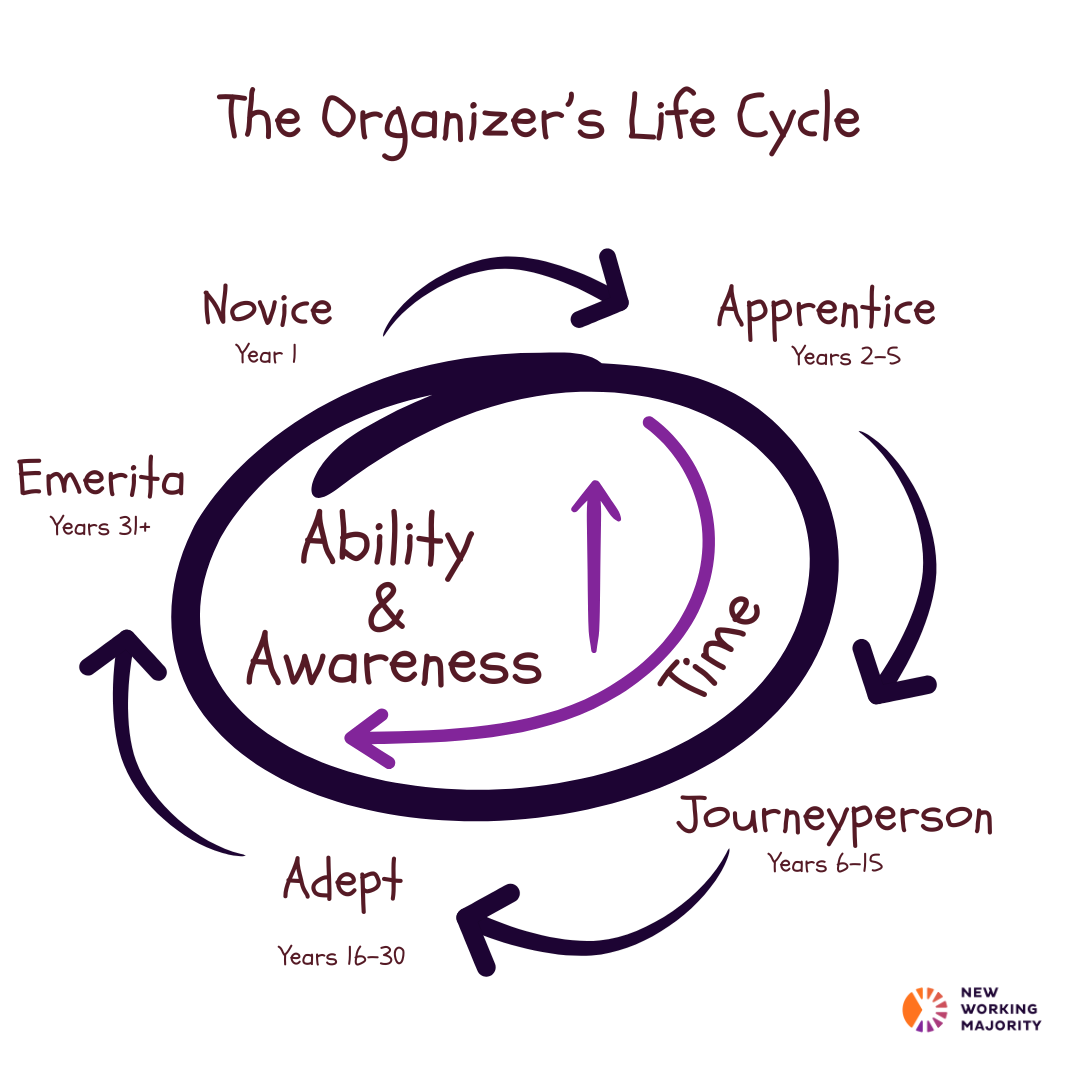
Journeyperson (Years 6-15)
Around year 6, organizers move into their Journeyperson stage. This could involve becoming a Lead Organizer or perhaps an Organizing Director in a smaller organization. Journeypeople are generally confident in their basic Ability skills, having had significant time to master them. They may be developing higher-level Ability skills, such as the ability to start and manage a coalition, or to plan and oversee a large-scale event. Journeypeople are often starting to take on mentoring roles, in addition to their formal supervision responsibilities.
When it comes to Awareness, Journeypeople are not only regular consumers of news in their area, they are also beginning to strategize about how to increase their own Awareness through relationships, gossip, oral history, and other organizers’ work. They should start to develop the habit of doing relational one-on-ones with others in their movement ecosystem, so that they are not just aware of their own organization’s work, but that of their peers.
Adept (Years 16+)
Like everyone else, the Adept must continue learning new Ability skills as they progress through their career. This will likely involve learning how to use new technologies, as few of us are still using the tech we started our careers with! But it also involves expanding our understanding of various tactics, and learning new organizing techniques from younger organizers, who are closer to the base-building work themselves.
The Adept also needs to continue to grow their Awareness, and will now also be in the role of passing on their Awareness knowledge to less senior staff in their own organizations. Rarely do these kinds of organizations have archives–if you want to know what happened ten years ago, you may need to talk to a person who was there then. Adepts often hold the living history of movement groups, and making sure that they have space to share their Awareness and perspectives is important.
When we talk to our clients about a position they are searching for, this organizer life cycle helps us to place the job in the context of the whole organization. Running a search for a group of Novice organizers for a union is different from looking for a Journeyperson who is going to be able to help a group of Novices and Apprentices grow their Awareness skills.
A healthy organization should have people in all stages of the organizer life cycle, and a commitment by all to growing their Awareness as well as their Ability skills. We hope this taxonomy helps you to think about whether your organization is focused on helping all organizers grow!
Money & Movement Seniority
If you read New Working Majority’s salary survey report in 2023, you know that one of the major findings of the report is that the people who are least happy with their movement salaries right now are the folks who have been in the movement the longest–in our taxonomy, the Journey People and Adepts. Obviously, this finding is worrisome, as we know that burnout is also affecting this group of staff, and the combination of inadequate pay plus burnout is a formula for senior people leaving movement work.
One of the most important steps that movement organizations can take to stop hemorrhaging staff is to embrace the concept of longevity pay, which is a feature of many union contracts. Longevity pay rewards people for their loyalty to the organization, and recognizes their growth within their current position. They are different from COLA raises, which recognize that the cost of living has gone up, and that existing salaries are degraded by those increases.
When combined, longevity raises (sometimes called ‘anniversary’ raises, because they can be aligned to the worker’s anniversary of starting that job) and COLA raises (which typically take effect at the beginning of a new calendar year) are a powerful retention measure for organizations that are frequently losing experienced staff. As we point out in the report, if you limit people’s ability to earn more money in their current job, you are giving them an incentive to apply for jobs with increased responsibility–whether you think they are ready for those roles or not. And staff who are frequently turned down for promotion will begin looking outside your organization for opportunities, if they fear they can never move up within the organization.
At New Working Majority, we’ve made the commitment to longevity raises, as well as to addressing the cost of living. We’ve decided that staff will receive a $2,000 bump in salary for every year they stay with us, in addition to an annual COLA raise. The $2,000 bump recognizes that, while we may not be able to offer a staff person a higher job title, we are still honoring the fact that they grew in their current role, over the course of the year.
If you are leading an organization that has experienced high turnover from late stage Apprentices and Journey People, consider that it might cost you less, in the long run, to pay your existing staff a little bit more from one year to the next than it will cost to replace them on an annual or semi-annual basis! And if you’re leading an organization that hasn’t experienced this yet, consider that longevity pay may help in continuing to prevent it in the future.
This post was originally published on New Working Majority’s blog “Hack the Movement” on March 15, 2025
How is Your Theory of Change Evolving?
It all begins with an idea.
Like many of you, I’ve spent this winter and spring trying to figure out what to do in this political moment. I’ve spent over thirty years evolving my personal theory of change, as my knowledge, understanding and experience of using different tactics grew. For most of that time, my theory of change has looked something like this:
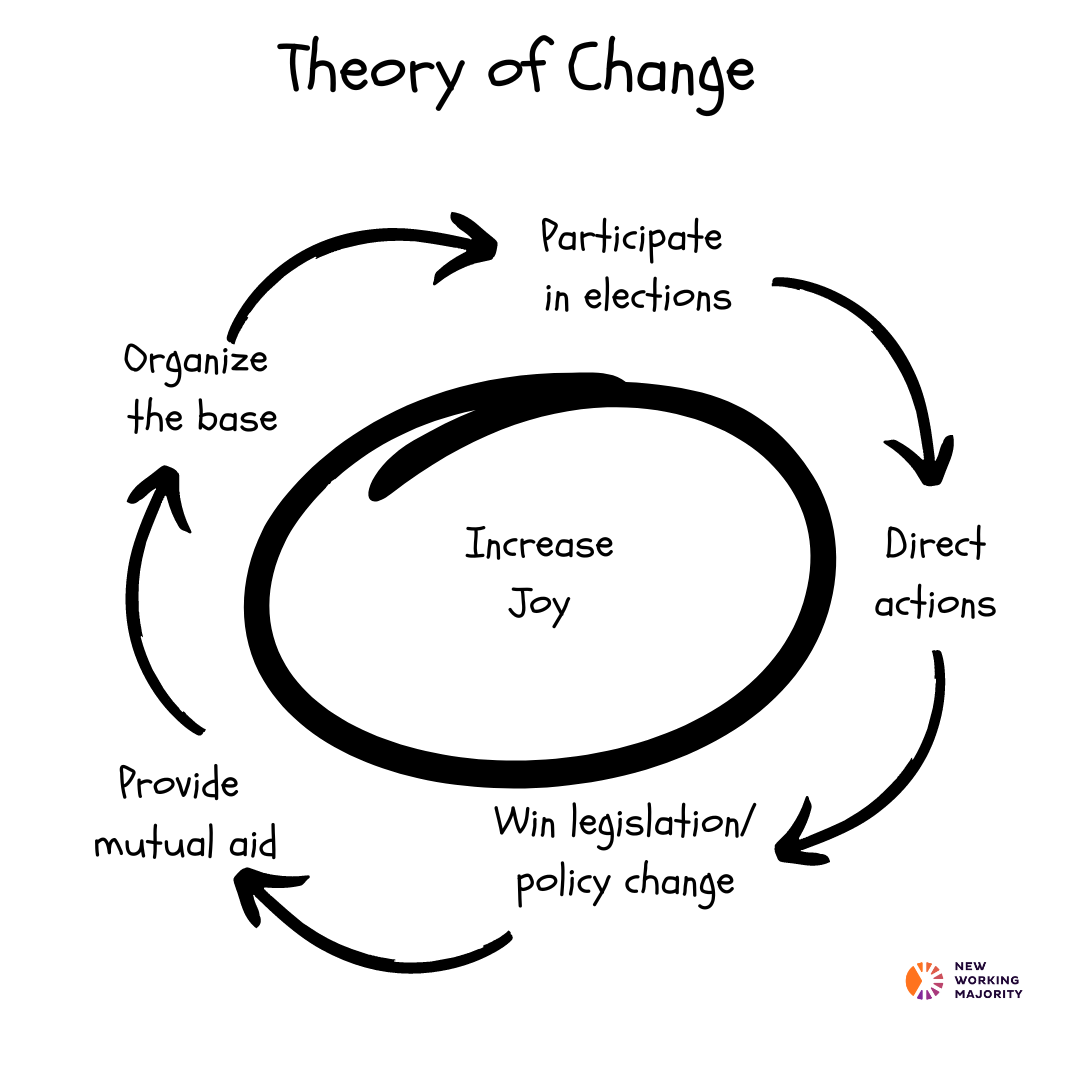
The things that notably were added to my own theory of change over time were “provide mutual aid” and “increase joy.” As someone who started her adult life as a queer person coming out during the early days of the AIDS crisis, and one who worked early on in the anti-nuclear movement, I’ve always recognized the power of direct action, and I’ve never been comfortable working in an organization where that tactic isn’t part of the theory of change. Direct action is not just about mass mobilization or giant protest marches for the sake of marching–it also includes things like the burning of draft cards, or spilling blood onto nuclear facilities, or occupying government buildings just to say “we’re here and you can’t ignore us.” And to me, there is no greater joy than working with workers and member leaders to develop as activists, through the process of base-building.
Over the course of the past few months, I’ve recognized that my theory of change no longer makes sense to me, in the context of the US’s slide into authoritarianism. For example–I’ve spent many years of my life working to engage people to participate in elections, and to engage in legislative and policy-making spaces, but I’m no longer convinced, with the time I have left, that those are as important to me personally.
That doesn’t mean I’m going to stop voting, or working with organizations that participate in electoral politics–but I’m having a hard time imagining saying, “they’ve got the money but we’ve got the votes” in a system that is entirely captured by money.
I developed this workshop to use with my own team and clients, to start to investigate how our own personal theories of change are evolving in this moment. I’ve decided that it’s useful enough that I’m sending it out to our list for use in other movement organizations.
Like many of you, I’m not yet ready to revise our organizational theory of change–but I’ll be thinking more about that this summer & into the fall. If you’re interested in talking about that, hit me up via the contact form to set up some time to talk. And if you do use this workshop, I’m curious to hear how it goes with your staff or volunteers, so feel free to email me about that, too. If we get positive feedback from this, we’ll do a similar workshop with an organizational theory of change focus later in the year.
This post was originally published on New Working Majority's blog "Hack the Movement" on June 11, 2025
Moving from Leadership to Emerita-level Mentorship
It all begins with an idea.
In the beginning, New Working Majority was a consulting shop of one–and one of my very first contracts as a consultant was with Make the Road Pennsylvania/Make the Road Action in PA (MRPA/MRAPA). The director of MRAPA at that time hired me to come and do weekly staff training and coaching with his small but mighty staff team of seven, most of whom had been hired from the organization’s membership base. Some of that involved working through individual organizing challenges, and some of it involved doing train-the-trainer work that would enable those organizers to lead workshops and trainings with members.
After I had been working with MRAPA for a little over a year, the director left suddenly, and Maegan Llerena, who had recently become the Deputy Director, asked me to stay on and continue working with them. Over the course of the next six months, Maegan moved into an interim director role, and was eventually hired as the permanent Executive Director of Make the Road PA/Make the Road Action in PA.
Maegan and I went on to work together, with me in a coaching role, for six more years. Over the course of that time, my engagement with MRPA went through many transformations, as Maegan was able to hire more staff. When we first started working together, I was the person in the room who had the most political experience–so I had more to do in preparing the staff for electoral work. In 2021, Maegan hired Diana Robinson as the Civic Engagement/Political Director for the organizations, and I stepped back from working directly with political staff and started coaching her.
In her earliest days as the permanent ED, Maegan had confided to me that she only planned to stay in that role for five years. That what she saw as her role was to build the organization to the point where it could survive her leaving, and that she would not be leaving her successor the disorganized place she had inherited. Together, over that five year period, we worked to see her vision through.
As the organization moved through the pandemic and grew larger, Maegan and I spent more time working on internal structure–building teams of different levels of management, holding retreats so that their staff could reflect, build camaraderie, and plan for future fights. And as the staff developed, I stepped further and further back from doing things myself, and more and more into an advisory role.
I’ve now had the experience, multiple times, of working with a group of young organizers to design and pull off meetings or events, where the director of the organization came to me after and said, “I felt so useless, I didn’t have to do anything except show up!,” but the first person to say it to me was Maegan. There is nothing useless about having developed your people to be able to act without you.
That’s a principle I’ve held tight onto for my whole career, and it is one I am glad to be able to pass on to others, as I continue to move in my Emerita era.
I ended my coaching with Make the Road PA at the end of 2024, with a triumphant closing of Maegan’s leadership of the organization. She has passed on the reins to Diana, as well as Patty Torres (the former Organizing Director), and now MRPA has co-Executive Directors, as the organization’s permanent staff is more than 30.
Today, I’m happy to announce that Maegan has moved into a national leadership role, as April 1st was her first day as the Co-Executive Director of Make the Road States/Make the Road Action. I can’t wait to see what she’ll do in that role, in this critical moment in our country’s history.
This post was originally posted on New Working Majority’s blog, “Hack the Movement” on April 3, 2025
Keeping Joy Alive as an Emerita
It all begins with an idea.
Thirty-four years ago, in a neighborhood near the Philadelphia airport, I knocked on my very first door as a canvasser. My ‘career,’ such as it was, is now old enough to have children of its own, if it were a person. In a lot of ways, organizing is a young person’s game. I have many, many coworkers, collaborators and allies who were not yet born when I knocked on that door.
Over the course of 34 years spent in movement organizations, I’ve won major legislative and electoral victories. I’ve helped working people form unions, and then taught them how to use their joint energy to make the world better. I’ve organized giant demonstrations, and led marches, and just generally had a blast, because if you’re not experiencing joy, why even do this hard, hard work?
A lot of that time, I did it in stiletto heels, full makeup and party dresses, carrying giant puppets, or dancing through downtown streets. Unfurling banners inside hotel banquet halls where rich guys talked about how they made money on the backs of the rest of us. Having art-making days, where members and volunteers painted signs, made props, wrote chants and songs and learned line dances to be able to protest with fun. Before anything else, I am a trained theater artist, and that training has informed my political work for my entire life.
Around this time last year, I wrote a post about my theory of the Organizer Life Cycle. Maybe even before I’m a trained theater artist, I am a teacher’s kid, and I need to teach people what I’ve learned in my life, or else again, why even do this hard, hard work?
Since I wrote that post last year, I’ve spent a lot of time reflecting about organizing life, and I’ve come to the conclusion that I need to add a fifth stage to the Life Cycle–that of Emerita–because that’s where I feel I am, at this point. The Emerita role is not retirement, per se. It’s more a realization that what I have to offer as a guide and advisor is more important than the work I can individually do myself. Partly, I’m just older and slowing down. But also, the type of advice I can give can make a difference for multiple campaigns or organizations, much more of a difference than if I were just running a single campaign or organization.
As part of my own transition to Emerita, I’ve gradually shifted from taking consulting contracts that involve direct organizing myself, to working as a coach with Executive Directors or Campaign Directors. Come back tomorrow to read about work with one client with whom I’ve spent a lot of time over the years…
This post was originally published on New Working Majority’s blog “Hack the Movement” on April 3, 2025
There’s No Organizing Without Organization
It all begins with an idea.
At the end of last year, several of my coaching clients asked me to help them come up with a work plan for 2025. Whenever that request comes, I ask folks to send me their department plan, or if they’re an executive director, their organizational strategic plan. All too often, the response I get is, “I can’t make a department work plan till I have my own work plan!” or “I can’t make an organizational plan until I know what our campaign work is going to be next year!”
Friend, you’re doing it backwards.
If you are holding a role in a movement organization, this is the time of year where you get to take back some control of your own life, but if you develop your work plan in a reactive way, you’re giving up that control before you get to making it.
I want to give an example about how we go about making work plans at New Working Majority, in the hopes that it will be helpful to others.
Step one: Identify Organizational Growth Goals
Several years ago, our team decided that we were going to expand our service offerings to include recruitment. We’d started doing some recruitment for existing coaching and organizational design clients–and when other people heard we were doing recruitment, they reached out for help with that. Because recruitment was becoming a stand-alone service, we needed to decide which of us, internally, was going to drive that growth–and we settled on Alina.
Step two: Identify Buckets of Work Around that Growth and Assign Them
Alina became our Recruitment and Data Manager, and her work plan for 2023 included things like doing a deep dive on the alumni offices of universities with labor studies programs, to find out if they had listservs to send out information to alumni about early career organizing jobs. This led to us participating in our first job fair (shout out to Rutgers SMLR!) in 2024, a practice we are planning to continue in 2025.
Other people on the team had responsibilities around recruiting as well. Dani, in her role as our Social Media & Marketing Manager is responsible for helping to recruit new clients, and also runs our weekly jobs newsletter and sells job ads. We knew that both of those things would be easier if we were able to connect with our own expanded professional networks on Linked In–so in 2024, Dani’s work plan involved a lot of learning about how LinkedIn marketing works.
Finally, after we had a first successful year in recruitment in 2023, we decided we needed to hire a Recruitment Director, which then went on Kati’s work plan for 2024. While Matthew ended up with the title of Senior Consultant instead, we never would have found him if we hadn’t done all the work that built that successful part of our business.
In the NWM example that I cited above, the work plan tasks were focused on effort, and in the first year, did not include specific outcomes. In other words–Alina had to do the work to figure out if any listservs existed before she could actively work with alumni offices to do recruitment. Her goal for that year was to do the research, and the end product was just a list of ways to get in touch with alumni offices. Later, we were able to set goals that involved metrics, but if we are in the research & experiment phase of growth, we want to have tasks that are experimental and may fail–because that’s how we learn things.
Step three: Mostly Don’t Focus on Specific Campaigns
It’s my pretty firm belief that most organizations should put less of their planning energy into campaigns, and more into planning staff development. I have developed a work planning template that generally asks people to limit their campaign & program work in one bucket. That’s counterintuitive to most people–mostly, people think the campaign work is the primary thing they need to get done in a year. And it’s true that most campaigns have external deadlines that drive us.
That’s why it is so important to have one’s work plan focused on the things that have internal or no deadlines. Your work plan is not a task list of things that you need to get done for OTHER people, it is a plan to do YOUR WORK.
In thinking about your work for the year, you need to think about your self-development goals (what do I want/need to learn?), your staff development goals (if you are a supervisor), your member leadership development goals, and crucial organizational goals like board development, fundraising, and teamwork and inclusion. Start putting those things on the calendar BEFORE you add in your campaign goals, so that you can develop a plan to use campaigns to develop leaders and staff.
What’s Next?
For 2025, New Working Majority’s major organizational goal is to fully launch a set of new training offerings. If you’re on our email list and reading our emails, you’ve probably seen announcements of some of our early efforts–look forward to more of that under Matthew’s oversight next year. He’s taking the lead on making sure that work moves forward–but all of us on our four-person team have a role to play in making our growth a success, as outlined clearly in all of our work plans!
This post was originally published on New Working Majority’s blog “Hack the Movement” on March 15, 2025.